




John Cena vs The Rock – The Rivalry That Defined an Era

If we talk about WWE’s biggest rivalries, one name always comes on top—John Cena vs. The Rock.
When we look at WWE history, there have been many legendary rivalries—Stone Cold vs. The Rock, Triple H vs. Shawn Michaels, and Undertaker vs. Kane. But if we talk about the most modern, emotional, and era-defining rivalry, the one that instantly comes to mind is John Cena vs. The Rock.
This wasn’t just another storyline. It was a clash of two different generations. On one side stood The Rock—the ultimate superstar of the Attitude Era, “The People’s Champion,” the man whose charisma, catchphrases, and Hollywood-level presence made him one of the most iconic wrestlers ever. On the other side stood John Cena—the man who carried WWE through the 2000s, becoming the face of the PG Era, the company’s most loyal soldier, and a true workhorse.
Their rivalry took WWE’s popularity and mainstream appeal to new heights. The promos, the matches, the fan reactions—everything felt so real that fans often wondered, “Is this actually personal?” And honestly, that’s what made it special.
The Beginning of the Feud
The seeds of this rivalry were planted in 2011. John Cena openly criticized The Rock, accusing him of leaving WWE and its loyal fans behind for a Hollywood career. Cena called him a sellout who “abandoned” the people who once supported him.

The Rock, never one to stay quiet, made a stunning return to WWE as the host of WrestleMania 27. That night, he made his intentions clear—he wasn’t just there to smile for the cameras. When he attacked Cena, the feud officially kicked off.
This moment shook fans. Cena was WWE’s top star at the time, working day in and day out, while The Rock was the returning legend trying to prove he still belonged. Fans instantly felt the tension—it wasn’t just a scripted feud; it had the flavor of real-life bitterness.
The War of Words
If there’s one thing that made this rivalry unforgettable, it was the mic battles. Cena and The Rock weren’t just wrestlers—they were masters of promos.
The Rock’s style was pure charisma and entertainment. His iconic catchphrases, like “Finally, The Rock has come back…,” would electrify the crowd. He made fans laugh, cheer, and chant along effortlessly.
Cena’s style was different—serious, direct, and cutting. He represented the voice of the modern WWE audience. He called Rock out for being fake, for showing up occasionally like a “guest star,” and for abandoning the grind.
The Rock fired back by mocking Cena’s neon T-shirts, his “You Can’t See Me” hand wave, and even his rap persona. Week after week, these verbal battles split the fans into two camps. You’d hear chants of “Let’s Go Cena!” and immediately, just as loud, “Rocky! Rocky!” It was like the stadium itself was divided into two worlds.
This wasn’t just trash talk—it was art. Both men were speaking from the heart, and that’s why fans connected with it.
WrestleMania 28—Once in a Lifetime
After months of anticipation, WWE announced the dream match—John Cena vs. The Rock at WrestleMania 28 (2012 in Miami). They even gave it the tagline “Once in a Lifetime.”

The buildup was massive. Every fan had the same question: Who would win? On one side was Cena, the hardworking face of WWE. On the other was The Rock, the returning legend with global stardom.
When the night finally came, the atmosphere inside Sun Life Stadium was electric. With over 78,000 fans in attendance, the energy was off the charts. And when The Rock defeated Cena clean, the crowd erupted. Miami was Rock’s hometown, so the victory felt even more emotional.
For Cena, this was a crushing defeat. Many fans still say this was one of the hardest losses of his career—the moment when the unbeatable face of WWE looked vulnerable.
WrestleMania 29 – The Rematch
But the story wasn’t over. The very next year, WWE announced the rematch—Cena vs. Rock at WrestleMania 29 (2013). This time, the stakes were even higher. It wasn’t just about pride; it was for the WWE Championship.
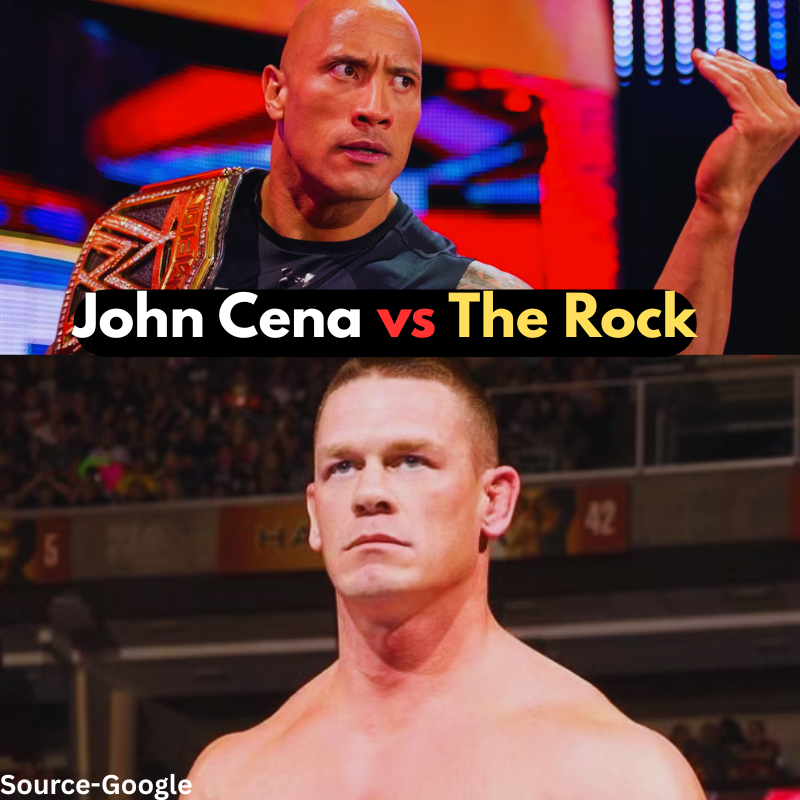
Cena was desperate for redemption. Rock had beaten him the year before, and now he was holding the title. The buildup once again was incredible—intense promos, press conferences, and a hype that had fans counting down the days.
Finally, in front of more than 80,000 fans at MetLife Stadium in New Jersey, Cena got his redemption. He defeated The Rock, reclaimed the WWE Championship, and silenced his critics.
What made this moment even more powerful was what happened after the match—Cena and Rock shared a hug in the middle of the ring. Both showed respect for each other, giving closure to one of the most personal rivalries in WWE history.
Impact on WWE and Fans
This rivalry wasn’t just about two matches or some heated promos. It had a massive impact on WWE as a whole.
Financially, it was gold. WrestleMania 28 and 29 both broke pay-per-view records for WWE. The merchandise sales of both Rock and Cena went through the roof. Every segment featuring them drew massive ratings.
But beyond the business side, it gave fans something magical. For the first time, fans of the Attitude Era and fans of the PG Era were united in one storyline. It felt like history was being made in front of their eyes. Two eras, two icons, colliding on the biggest stage possible.
Legacy of the Rivalry
Today, whenever people discuss WWE’s greatest rivalries, Cena vs. Rock is always on the list. What made it different was how personal it felt. Rock represented the past—the charisma, the larger-than-life aura of the Attitude Era. Cena represented the present and future—the never-give-up attitude, the hard work, and the consistency that kept WWE alive.
For Cena, defeating The Rock at WrestleMania was one of the defining moments of his career. For The Rock, coming back and headlining back-to-back WrestleManias proved that even after years in Hollywood, he was still loved as “The People’s Champion.”
It wasn’t just a feud. It became a cultural moment in WWE history—one that fans still talk about more than a decade later.
Conclusion
John Cena vs. The Rock wasn’t just a wrestling rivalry—it was a story that defined an entire era. From the fiery promos to the emotional moments to the back-to-back WrestleMania main events, everything about it felt historic.
For fans, it was more than entertainment—it was a dream match come true. Even today, when people hear the phrase “Once in a Lifetime,” they instantly remember that epic night in Miami and the redemption story in New Jersey.
This rivalry proved one thing—when WWE creates a storyline that feels personal, emotional, and larger-than-life, it doesn’t just entertain. It creates history.